If you’ve started shopping for a Dallas-Fort Worth wedding photographer or videographer, you’ve probably noticed something wild: one quote lands at $900, another at $3,000, another at $8,000, and another at $20,000 — and on paper, they all say “wedding photography package.” So what gives? Grab your iced coffee, because we’re about to pull back the curtain on how the DFW wedding photography pricing world actually works, why the spread is so enormous, and what you should actually look for before you sign a contract with any Dallas, Fort Worth, McKinney, or Aubrey wedding photographer.
What Does “Wedding Photographer” Actually Mean in Texas?
Here’s the truth nobody tells you: there is no license required to call yourself a wedding photographer in Texas. No certification board. No minimum years of experience. No test you have to pass. All it takes to hang out a shingle is a camera and the willingness to say “book me.”
That’s not a knock on anyone — it just means the barrier to entry is basically the cost of a decent camera body and a lens, which you can find used for a few hundred dollars. Compare that to becoming a hairstylist (which requires licensing hours and an exam) or an event planner with insurance requirements, and you start to see why the DFW wedding photography market has such a wide spread of skill, professionalism, and price.
Because the entry point is so low, the Dallas-Fort Worth photography market ends up with people at wildly different stages, all competing for your wedding date. Let’s walk through what those stages actually look like.
The 4 Levels of Wedding Photographers in the DFW Area
1. The Enthusiast
This is where almost every photographer starts. Someone gets a camera as a gift or an impulse buy and starts photographing their kids, their dog, their friend group at brunch. The photos get posted, the compliments roll in (“OMG you should charge for this!”), and suddenly they’re promoting themselves as a freelance photographer — with zero business experience, no contracts, no backup equipment, and no formal training in things like posing, lighting, or the editing consistency it takes to deliver hundreds of images that all look intentional.
2. The Hobbyist
This is the enthusiast, leveled up. They’ve been at it a while, own multiple lenses and camera bodies, and shoot everything — family sessions, landscapes, concerts, car shows, Comic-Con. They’re genuinely skilled and their portfolio is growing, but photography is a passion project, not a business. There’s rarely a real contract, insurance, or a repeatable, professional workflow behind it.
3. The Side Hustle
This person works a regular 9-to-5 and actively promotes their photography services on the side, shooting weddings and sessions on weekends. They’re often quite talented and building real momentum — but because photography isn’t their primary income, pricing tends to reflect “extra money” math rather than the true cost of running a business.
Enthusiasts, hobbyists, and side-hustlers together make up roughly 75–85% of photographers in the DFW area. That’s the overwhelming majority of the market — which is exactly why so many quotes you’ll get land under $2,000.
4. The Full-Time Wedding Photography Professional
This is the remaining 15–25% of the Dallas-Fort Worth wedding photography market — the photographers for whom this is not a side project, but a real, full-time business with real overhead, real experience, and real reputations on the line. This is also where TinTin Wynn Photography & Films lives.
This distinction matters more than people realize, because it changes everything about how pricing works and how your wedding day actually gets handled.
What It Actually Costs to Run a Professional Wedding Photography Business
A full-time professional isn’t just pricing for the hours they spend at your wedding — they’re pricing to sustain an entire business behind the scenes. Here’s what that includes:
- Business & liability insurance — protecting you, your venue, and their equipment, often a requirement just to shoot at many DFW venues
- Professional-grade equipment — multiple camera bodies (so a single equipment failure never means missed moments), backup lenses, flashes and lighting gear, and redundant storage for your images
- Business management software — client management systems, contracts, invoicing, online galleries, scheduling tools, and album design platforms, all carrying monthly subscription costs
- Cost of acquiring clients — marketing, a professional website, advertising, styled shoots, and hours spent on consultations that don’t always convert into a booking
- Taxes — as a self-employed business owner, a professional pays self-employment tax on top of income tax, which alone can account for 25–30% of revenue
- Experience and continued education — workshops, mentorships, and years of trial and error that happened long before your wedding day, so you don’t have to be the one it’s practiced on
- Time beyond the wedding day — culling, editing, client communication, timeline planning, and album design routinely add up to 20–40+ hours of unseen work per wedding
None of these costs are optional for a professional — they’re the cost of being reliable. When a full-time Dallas or Fort Worth wedding photographer’s pricing feels higher, it’s rarely about greed. It’s about what it actually costs to guarantee someone shows up on time, insured, backed up, and equipped to deliver, no matter what happens that day.
DFW Wedding Photography Price Breakdown by Tier
| Price Range | Typical Photographer Level |
|---|---|
| Under $1,500 | Hobbyists & Enthusiasts |
| $1,600 – $2,000 | Side Hustlers |
| $2,500 – $3,500 | Full-Time Professionals |
| $3,800 – $6,000 | Full-Time Professionals in High Demand |
| $7,000 – $9,000 | Mid-Market, Entering Luxury |
| $10,000 – $20,000 | Luxury Market |
| $25,000+ | Ultra-Luxury, Celebrity & Beyond |
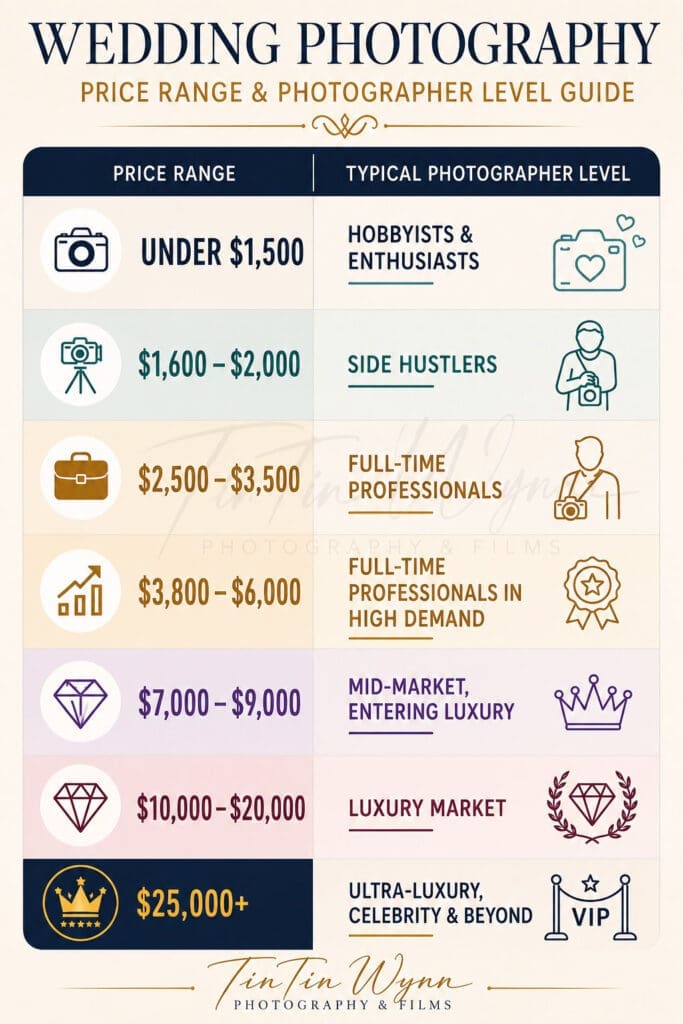
The jump from one tier to the next isn’t arbitrary — it reflects experience, demand, team size, and the level of craft and reliability baked into the service.
What Actually Makes a Wedding Photographer Different From Any Other Photographer?
This is the part most couples never think to ask about, and it’s the biggest reason experience is worth paying for.
It Takes Years to Master the Wedding Day Flow
Weddings follow a loose, but very specific, rhythm. A photographer who has shot hundreds of them understands that rhythm instinctively — they know how to weave in and around the timeline, keep the day moving without unnecessary interruptions, and work calmly under high stress and limited time. Something as simple as capturing beautifully posed, candid, editorial-style couple portraits in just 15 minutes is a skill that takes years to build. It’s not just “take pretty pictures” — it’s choreography, direction, and instinct, all happening in real time.
Lighting Is the Real Skill — and It’s Learned the Hard Way
Most photographers take 5 to 8 years to become truly proficient in reading and shaping light, and a wedding day throws nearly every lighting challenge imaginable at you — sometimes all in the same hour:
- Indoor getting-ready spaces are often tight and dimly lit with tungsten bulbs, which cast yellow or orange skin tones if not corrected properly.
- Indoor ceremonies frequently place the couple in front of a large window. This creates a lighting mismatch: the couple is bright and cool-toned while the seated guests are lit by warm chandeliers — a recipe for over- and under-exposed images with muddy, inconsistent skin tones across the same photo.
- Outdoor ceremonies bring harsh direct sunlight, constantly shifting light as clouds move in and out, and situations where the couple stands in shade while guests sit in direct sun — again creating exposure and color-cast mismatches within a single frame.
- Receptions are where inexperience shows the fastest. Many enthusiasts, hobbyists, and weekend photographers have little to no experience shooting with flash, and some assume a wide-aperture lens (like an f/1.2) means flash isn’t necessary. It is. Without it, low reception lighting quickly leads to soft, blurry, underexposed images.
This is also what separates a wedding photographer from a portrait photographer who specializes in family sessions, seniors, or maternity. Portrait photographers are used to controlling their conditions — shooting during golden hour, under a shaded tree, or inside a studio where light never changes. A wedding day offers no such luxury. Light shifts a minimum of ten times across a single day: the bridal suite, the groom’s suite, flat-lay detail shots, the dress details, dining room details, outdoor venue details, first look, ceremony, family formals, reception entrance, cake cutting, dancing, and the grand exit. An experienced wedding photographer in Dallas or Fort Worth knows how to adapt instantly — understanding how color temperature shifts between indoor and outdoor, shade and sun, window light and recessed lighting or chandeliers, so every image feels cohesive, not like it was shot by five different people.
On top of all of that, there’s shot list planning, coordinating family and guests, and managing the reality that any wedding day involves 5–10 vendors, a full bridal party, and dozens of moving parts — meaning something will inevitably shift. An experienced wedding photographer helps you navigate all of it, adjusting the timeline on the fly without missing the moments that matter.
The Business Side of Reliability
Experience isn’t the only thing you’re paying for — you’re also paying for accountability.
Professional studios carry business insurance to protect against accidents and equipment mishaps, and they have a business reputation to protect. If a professional delivers late, shows up late, or provides poor service, it directly damages a business name they’ve spent years building — which gives them every incentive to get it right.
Hobbyists and enthusiasts, by contrast, often don’t carry a business license or insurance, which makes it far easier to change names, disappear, or leave a client without recourse if something goes wrong. Even side-hustlers, who are often talented, are typically balancing photography around a full-time job with no insurance and no backup team — so if their employer calls them in unexpectedly, or a personal emergency comes up, cancellations can happen with little warning.
It’s also worth asking any photographer you’re considering — especially a solo shooter — what their backup plan is if they’re unable to shoot your wedding due to illness, injury, or another unexpected life event. A true professional will have an answer ready; for many hobbyists and side-hustlers, there simply isn’t one.
How to Vet a Wedding Photographer in Dallas-Fort Worth
Before you book anyone, ask to see at least three full wedding galleries. A full gallery should show every part of the day, with 10+ photos from each segment: bride prep, groom prep, flat-lay details, ceremony, family formals, reception entrance, cake cutting, dancing, and the send-off. This is the only real way to gauge someone’s true skillset across the full range of conditions a wedding demands.
Be cautious of websites and portfolios that only show beautifully dressed couples in soft, perfect light with no wedding party, no ceremony, no reception, no grand exit. Often, these images come from something called a styled shoot: an event hosted by a wedding planner or company that specializes in producing content for photographers. These shoots hire professional models to wear wedding attire at a beautifully decorated venue, complete with a fully dressed ceremony arch, a reception table set with china and silverware, a wedding cake, florals, balloons — every visual element of a real wedding, minus the wedding itself.
The “couple” in these photos are models who know exactly how to move, pose, and find their angles. They’re professionals at looking like the perfect wedding couple. Combine that with a curated venue, ideal lighting, and unlimited time with no timeline pressure, no real ceremony, and no guests to manage, and you get flawless, magazine-worthy images. Styled shoots are a completely normal and valuable tool for photographers building their portfolio (even experienced ones use them) — but they prove polish, not the ability to handle a real wedding day. Beware of a portfolio built entirely on styled content — it tells you almost nothing about how someone performs under the actual pressure, timeline, and chaos of your wedding.
Frequently Asked Questions About DFW Wedding Photography Pricing
How much does a wedding photographer cost in Dallas-Fort Worth? DFW wedding photography prices typically range from $800 for hobbyists to $25,000+ for ultra-luxury studios, with full-time professionals generally falling between $2,500 and $9,000 depending on experience, demand, and coverage.
Why is there such a big price gap between wedding photographers? The gap reflects experience, business overhead, insurance, equipment redundancy, and the 20-40+ hours of unseen editing and planning work behind every wedding — not just the hours spent shooting on the day itself.
What should I look for before booking a Dallas or Fort Worth wedding photographer? Ask to see at least three full wedding galleries (not just styled shoots), confirm they carry business insurance, and ask about their backup plan in case of illness or emergency.
The Bottom Line
None of these levels are inherently good or bad — a hobbyist might be a perfect fit for a laid-back backyard wedding. But if you’re planning a wedding that’s a true reflection of your love story, it matters who’s capturing it, because unlike the cake or the flowers, the photos and film are the only thing you get to keep forever.
The price gap between photographers isn’t random. It’s the gap between someone still building their skillset and someone who has already spent years — and thousands of dollars in business investment — earning the right to be trusted with the most important day of your life.
At TinTin Wynn Photography & Films, we specialize in candid, editorial-inspired wedding photography and cinematic films for couples across Dallas, Fort Worth, McKinney, and Aubrey, Texas. If you’re newly engaged and want to talk through what your day could look like, we’d love to hear your story — reach out and let’s chat.

